Pelvic Floor Revisited: Spiraling In - 8 - Shoulders Down, Floor Up
Pelvic Floor Revisited: Spiraling In - 8 - Shoulders Down, Floor Up
Directing power through the core via torso and ground forces
Based on “Restorative Rhythms 8 – Restorative Undulations” as taught by David Zemach-Berson, GCFT®
We return to timing and its affect on ease, grace and power. This lesson, part of David Zemach-Berson’s Restorative Rhythms series, opens up a connection between the shoulders and ribs and pelvic floor. Not in his original version, but that’s where we will be taking it.

The back and rib muscles support the ribs in respiration, allowing the pelvis to align and support the torso. Source: Anatomy and Asana: Preventing Yoga .
When I looked up “connection pelvic floor and shoulders,” the Google AI response was surprisingly (to me) rich with references.from the National Institutes of Health and other medically reliable resources. To summarize and quote directly:
The pelvic floor and shoulders are deeply integrated through a continuous kinetic chain linked by fascia, breathing mechanics, and postural alignment. When one area experiences tension or misalignment, it directly compromises the function of the other; slouching shoulders or rounded back lock the ribcage in place and throw the whole system out of alignment.
Myofascial slings, interconnected networks of muscles, fascia, and ligaments that work synergistically to coordinate multi-joint movements, stabilize the spine and pelvis, and transfer forces between the upper and lower body. Large muscle paths (like the latissimus dorsi in your back connect to the gluteal muscles on the opposite side) cross the torso. Any restriction or weakness in your shoulder blade mechanics alters the tension down these slings, forcing the pelvis and pelvic floor to overcompensate.
Chronic shoulder tension or slouched, rounded shoulders lock your ribcage in place. This prevents the respiratory diaphragm from expanding fully, which forces shallow chest breathing and subjects the pelvic floor to constant, unyielding downward pressure. Even the vocal cords can be affected by a restricted respiratory diaphragm.
Research shows that the pelvic floor naturally contracts fractions of a second before you move your arm. This creates a stable anchor. If the pelvic floor is weak or hypertonic (too tight), your shoulder stabilizers lack a solid foundation, often culminating in chronic shoulder blade or rotator cuff pain.
The jaw, shoulders, and pelvic floor act as the body's primary stress-holding centers. Under emotional stress or physical strain, the nervous system triggers systemic guarding. Clenching your jaw or hiking up your shoulders almost always co-occurs with unconscious gripping of the pelvic floor muscle.
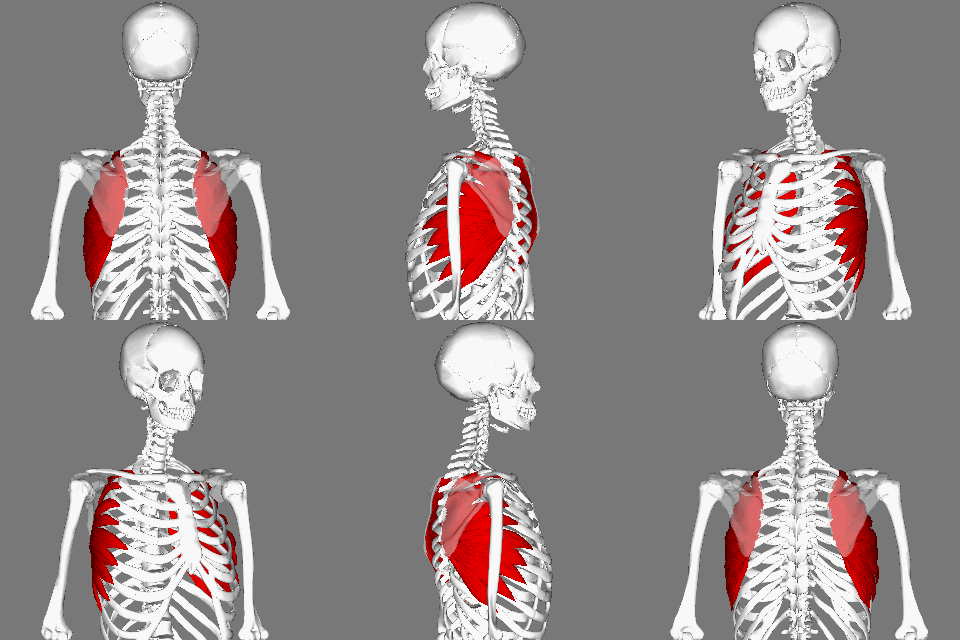
The serratus anterior muscel holds down the shoulder bledes, and is linked to respirtaion as it stabilized the chest enabling the diaphragm to move.
The serratus anterior is the shoulder muscle is largely responsible for shoulder movement and chest stability in respiration. As the psoas helps support respiration and flexes the hip, the serratus anterior stabilizes the ribs during respiration and moves the arm. In dynamic movement, psoas and serratus coordinate diagonally to stack the spine and ground the pelvis.
As the respiratory diaphragm and pelvic floor descend with the inhale, the shoulders glide back to give the ribs room to expand into. As the diaphragm and pelvic floor lift on the exhale, the shoulder blades slide outward against the ribs to stabilize the arm socket, support a stacked spine, and transmit energy down from the shoulders to the pelvis. Movement is anticipated in the pelvic floor, which contracts in preparation.
We are going to explore the timing relationship between the movement of the shoulder and breath and the pelvic floor. Lying on the floor with an arm lying on the floor as if reaching for the back wall, we bring attention to how each part of the serratus anterior muscle adjusts the ribs and shoulder blade to the inhale and exhale. As we gain proficiency in sensing our own optimal timing, we connect the shoulder to the pelvis and pelvic floor.
This lesson is yet another opportunity to harmonize pelvic support, ground forces, and breath for power and control. Bring your cork if you like practicing soft face and lips.

Visualizing the front support system, from leg through pelvis to chest. This support allows you to breathe and move.
Source: Anatomy and Asana: Preventing Yoga
Science Nerd Candy Bowl:
Serratus Anterior: Shoulder Series, Part 11 (3D Animation) - Anatomy Lab (2:06) - animation of the serratus anterior as it moves the ribs and shoulder blade
The serratus anterior - 3D Anatomy Lyon (2:38) how the muscle moves the shoulder in relationship to other muscles
Best Psoas & Diaphragm Exercise for Improved Breathing - Tune Up Fitness (5:38) - an anatomical review of the relationship between the psoas, respiratory diaphragm, and pelvic floor (0:32-1:15), demonstration of strengthening exercises very much like this lesson
Timing matters. Get your groove on and experience what it’s like to be in the pocket. For music, for walking, for lifting, for just about everything.
Set up for supine lesson
Support for knees and back of the head for supine segments, if desired
OR seated in a chair that allows movement on both sides, knees and hips level
How you might feel after this lesson: Breathing coordinated with walking; Hips open and comfortably aligned; Legs aligned in hip sockets, with ground forces flowing easily from foot to hip to hand; Shoulders surprisingly released; Upper back and chest looser and more flexible; Sense of when the pelvic floor is relaxing.